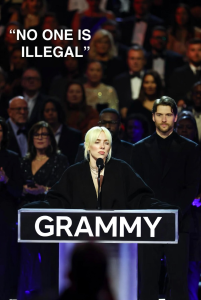
LOS ANGELES — Billie Eilish turned one of music’s biggest nights into a lightning rod for political debate after using her Grammy Awards acceptance speech to criticize U.S. Immigration and Customs Enforcement (ICE), triggering immediate backlash across social media and cable news — and prompting a fierce defense from her brother and collaborator, Finneas.
Eilish, 24, took the stage Sunday night alongside Finneas after the siblings won Song of the Year. While the moment initially followed the expected tone of gratitude, the speech quickly shifted when Eilish addressed immigration policy, delivering remarks that many viewers described as bold, confrontational, and deeply polarizing.
“No one is illegal on stolen land,” Eilish said, before adding a sharply worded condemnation of ICE that was partially censored during the live broadcast. Both Eilish and Finneas were seen wearing pins reading “ICE OUT,” signaling the message before she even spoke.
Within minutes, clips of the speech began circulating online, racking up millions of views and sparking heated debate. Supporters praised the singer for using her platform to speak out on human rights, calling the moment powerful and necessary. Critics, however, accused Eilish of politicizing a music awards show and questioned her credibility as a wealthy celebrity commenting on immigration enforcement.
Social Media Erupts
The reaction online was swift and divided. On one side, fans and activists applauded Eilish for addressing immigration at a time when the issue remains deeply contentious in the United States. Many described her words as courageous, arguing that artists have a responsibility to speak out on social issues.
On the other side, critics accused her of hypocrisy, privilege, and oversimplifying complex policy issues. Some argued that her comments were inappropriate for a televised awards show meant to celebrate music, not politics. Others zeroed in on her “stolen land” remark, questioning whether celebrity activism truly contributes to meaningful change.
The backlash quickly spilled beyond fan communities and into political commentary, with commentators debating whether high-profile entertainers should weigh in on government policy at all.
Finneas Pushes Back
As the criticism intensified, Finneas took to social media to defend his sister — and he did not hold back.
In a series of posts, Finneas called out what he described as a wave of outrage from powerful figures angered by a young woman speaking her mind on a global stage. He mocked critics who claimed celebrity opinions do not matter, pointing out that the same voices were now dedicating days of coverage to attacking Eilish for her remarks.
His most controversial response included a pointed jab at prominent critics, suggesting that their outrage rang hollow given broader issues of power and accountability. The post went viral almost instantly, amplifying the controversy and drawing even more attention to Eilish’s original speech.
Supporters hailed Finneas for standing up for his sister and refusing to soften the message. Detractors accused him of escalating the situation and deflecting from the original criticism. Either way, the siblings dominated headlines for days following the ceremony.
A Politically Charged Grammys
Eilish was not alone in using the Grammy stage to address immigration. Several artists throughout the night referenced social justice issues, signaling a broader shift toward overt political expression at major entertainment events.
For some viewers, the Grammys felt more relevant than ever — a reflection of cultural tensions playing out in real time. For others, it marked an uncomfortable blending of entertainment and ideology.
The debate underscored a growing divide in how audiences view celebrity activism. Younger fans largely defended Eilish’s right to speak, while critics questioned whether awards shows should remain politically neutral — if that is even possible anymore.
What Comes Next
Neither Billie Eilish nor Finneas has issued an apology or walked back the remarks. If anything, their responses suggest they are prepared to stand firmly behind their message, regardless of backlash.
Industry insiders note that controversy has rarely slowed Eilish’s career, which has thrived on authenticity and emotional honesty. While the speech may alienate some listeners, it has also galvanized her fan base and reinforced her image as an artist unafraid to challenge power.
As the conversation continues online, the moment has become emblematic of a larger cultural shift — one where pop stars are no longer expected to stay silent, and where awards shows increasingly double as platforms for protest.
Whether praised or condemned, Billie Eilish’s Grammys speech ensured one thing: the conversation didn’t end when the music stopped.