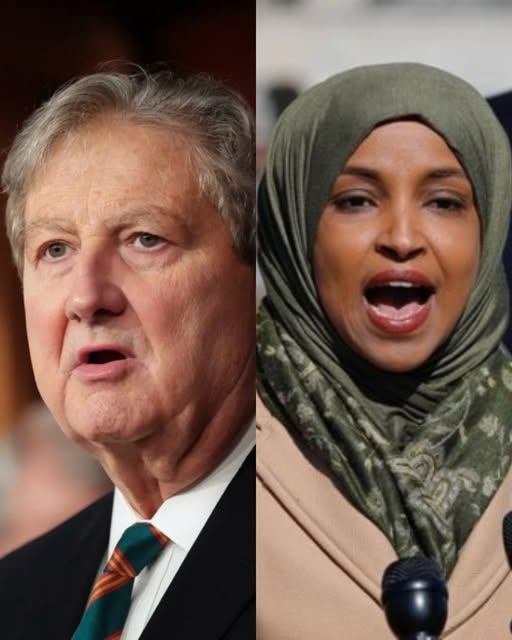
Every camera locked on him like a firing squad.
The room — a symphony of soundbites seconds earlier — fell into a silence so precise it felt surgical.
Omar’s words faltered mid-sentence.
AOC’s confidence flickered — just long enough for the stillness to take hold.
Then Kennedy inhaled.
And in that breath, something subtle yet seismic shifted.
The balance of the room.
The current of narrative.
Even the illusion of moral certainty.
It was as if history itself leaned forward and whispered, “Listen.”
He didn’t raise his voice. That was the first shock.
In a chamber addicted to outrage and performance, his calm landed like rebellion.
He spoke not to the cameras, but to conscience — about duty as a covenant, not a costume.
About power as stewardship, not ownership.
Every word carried the quiet authority of someone who had remembered what public service once meant.
The marble walls seemed to draw closer. The restless aides stopped typing.
Even the cameras, forever hungry for heat, seemed to lose interest in the absence of noise.
Omar’s hand lowered from the mic.
Ocasio-Cortez straightened, not in resistance but in thought — recalibrating, as if suddenly aware that the real contest wasn’t between parties or ideologies, but between authenticity and performance.
Kennedy wasn’t attacking anyone.
He was naming a sickness — a politics that had traded substance for spectacle, duty for display.
For a brief, unguarded moment, no one was campaigning.
No one was trending.
They were simply human beings entrusted with a fragile inheritance:
the right to lead, the responsibility to listen.
And in the echo of that calm voice, a question hung in the marble air —
not shouted, not debated, but quietly unavoidable:
Are we still worthy of the power we hold?