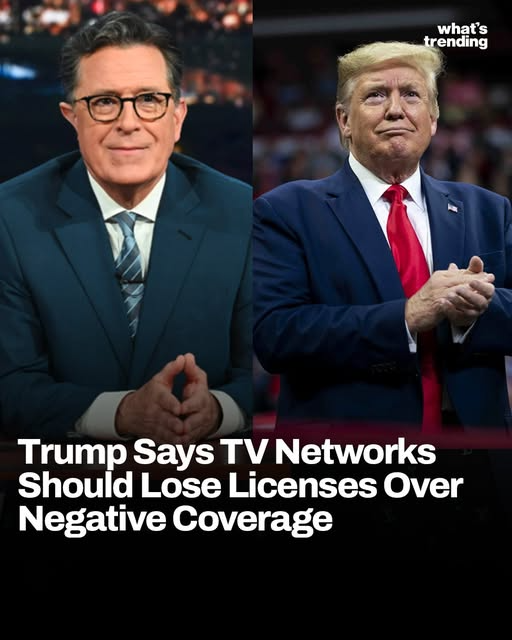
Former President Donald Trump on Wednesday renewed his criticism of U.S. television networks, arguing that broadcasters should lose their licenses if their news coverage and late-night programming are “almost 100% negative” toward him and the Republican Party.
In a post on his social media platform, Truth Social, Trump accused major broadcast networks of political bias and singled out late-night television hosts as examples of what he described as unfair and hostile coverage. Among those mentioned was The Late Show host Stephen Colbert, whom Trump called “talentless” and claimed was suffering from low ratings. CBS has announced that The Late Show is scheduled to end in May 2026, though the network has not publicly linked that decision to political factors.
Trump’s comments are part of a long-running pattern of attacks on the media, which he has frequently labeled as dishonest or partisan. During his presidency and since leaving office, Trump has repeatedly suggested that the federal government should take punitive action against broadcasters he believes are biased, including revoking licenses or increasing regulatory scrutiny.
Broadcast licenses in the United States are overseen by the Federal Communications Commission (FCC), an independent federal agency. However, the FCC has consistently stated that it does not regulate the editorial content of news or entertainment programming. Federal law and the First Amendment sharply limit the government’s ability to interfere with or punish broadcasters based on viewpoint or criticism of public officials.
Legal experts note that broadcast licenses are granted to local stations—not networks—and that licenses can only be revoked for specific technical or legal violations, not for political speech. “The idea that licenses could be pulled because coverage is negative toward a political figure is directly at odds with the First Amendment,” said one media law scholar, who emphasized that government retaliation against critical media would face overwhelming legal challenges.
Late-night television has long leaned into political satire, particularly during election cycles and periods of political controversy. Colbert, along with hosts such as Jimmy Kimmel and Seth Meyers, has built much of his monologue content around criticism of Trump and Republican leaders, a style that has proven popular with many viewers but has also drawn sharp criticism from conservatives.
Trump’s latest remarks come as media bias and regulation remain hot-button issues among Republican voters. Several GOP lawmakers have echoed complaints about what they view as ideological imbalance in mainstream media, though few have directly endorsed revoking broadcast licenses over content.
The FCC reiterated its position in past statements responding to similar claims, stressing that “the Commission does not censor and does not have authority to revoke licenses based on the viewpoints expressed by broadcasters.” The agency has also noted that attempts to do so would violate longstanding legal precedent protecting press freedom.
While Trump’s comments are unlikely to result in immediate regulatory action, they underscore the continued tension between the former president and major media organizations. As the 2024 election cycle continues to shape political discourse, Trump’s attacks on the press remain a central feature of his public messaging, energizing supporters while raising renewed concerns among press freedom advocates about the normalization of government threats against independent media.